
-
Welcome, Guest
- ( My Account | View Cart | Login )
|
|
| Our Local Time Is 3:52:16 PM. |
| Call us at 818-786-0600. We are here to help! |
 |
ON SALE NOW Introducing the Polaris Lab Water Systems High Purity Water Made In The USA. Click here for more info. |
| Laboratory Water Systems | Laboratory Process Filters | Laboratory Equipment | Water Treatment |
|
KDF® 55
and 85 Process Media in Point-of-Entry
Water Treatment Systems
– Chlorine, Iron
and
Hydrogen Sulfide Reduction
Purchase KDF Media Here KDF Process Media are high purity copper-zinc granules that reduce contaminants in water using oxidation/reduction (redox) reaction. KDF 55 process medium is an effective chlorine removal agent used in point-of-entry (POE) treatment of municipal water supplies. KDF 85 process medium is an effective iron (ferrous) and hydrogen sulfide (H2S) removal agent that may be used alone or to protect existing water filtration/purification technologies in POE treatment of groundwater supplies. These
unique, innovative and environmentally responsible media consist of high
purity copper-zinc granules that use redox (the exchange of electrons) in
patented products to effectively reduce/remove chlorine, iron, hydrogen
sulfide, heavy metals,
and control microorganisms in potable water without the use of chemicals.
What’s more, KDF 55 and 85 media are highly efficient and tank size
requirements are modest for more economical system engineering and installation. Medium
Requirements and System Sizing Easily
the most critical aspect of pressure filter performance is the relationship of
flow rate to surface of KDF media. Inaccurate sizing is the most common reason
for trouble in filter systems. The nominal flow rate in the service cycle
depends on surface area available. For most types of filter media, the service
flow rate must not exceed
five gallons per minute (gpm) per square foot of surface area, with at least a
30-inch filter bed depth. Service
flow rates with KDF Process Media,
however, may be calculated at 15 gpm
per square foot of surface area (0.104 gpm per square inch). This
is three times the effective flow rate
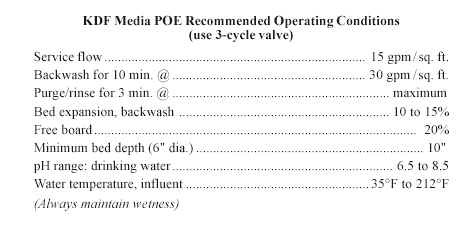
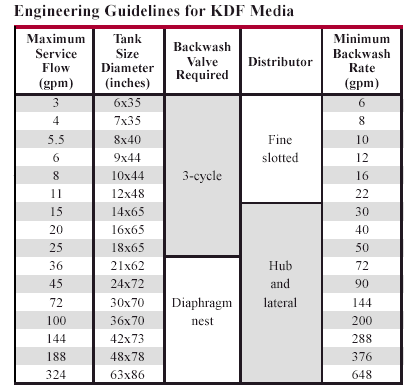
of other filter media. Backwashing KDF Process Media In electrochemical reduction processes, surface products are formed when KDF® media are used in point-of-entry (POE) water treatment systems. These byproducts, along with any calcium and magnesium precipitate, must be periodically backwashed. For backwash rates of 3 to 25 gpm, use a high quality 3-cycle backwash valve (service, backwash, purge). One with a high-flow backwash mode is best. For 36 to 324 gpm, use a diaphragm nest valve. Remember to remove any backwash flow restrictors. Select a distributor based on backwash flow rate. For 3 to 11 gpm, use a fine slotted distributor and for 15 to 324 gpm, use a hub and lateral distributor (#8 garnet underbedding is recommended). Time the backwash cycle for ten minutes and purge for three minutes. Backwash at least three times per week, more frequently if necessary, depending upon the quality of the water supply. If more backwashing is required, repeat the entire cycle. Backwash flow rates are a function of backwash water temperature; type, size and density of media; and the specific design of the pressure filter. KDF Process Media have a density of 171 pounds per cubic foot, which makes it a very high density medium requiring a backwash flow rate of twice the service flow. KDF media require 30 gallons per minute per square foot of bed surface area. Very cold water requires somewhat lower backwash rates and warmer water requires higher rates. Do not restrict pipe size to the drain. Note:
If
backwashing procedures are not properly followed, KDF Process Media may become
fouled.
|



* Flat Rate UPS shipping when able to ship via UPS and is in the USA excluding Hawaii and Alaska.
Larger Items may not be able to ship via UPS, in that case freight charges will be quoted seperately.
International shipping will be quoted after the order is placed. You will have the opportunity to cancel before we finalize your order.
Terms and conditions
Credit Application
Privacy Policy
List All Products

Clack is a registered trademark of Clack corporation
Powered by Wilson Web Engineering